


Laparoscopic myomectomy is a minimally invasive keyhole surgery to remove fibroids from the uterus while preserving the uterus.
This procedure is commonly performed for women who have fibroid-related symptoms such as heavy menstrual bleeding, pelvic pain, pelvic pressure, urinary frequency, constipation, pain during intercourse, infertility, or recurrent pregnancy loss where fibroids may be contributing.
Unlike hysterectomy, laparoscopic myomectomy does not remove the uterus. The aim is to remove the fibroids causing symptoms while preserving the uterus and supporting future fertility potential whenever possible.
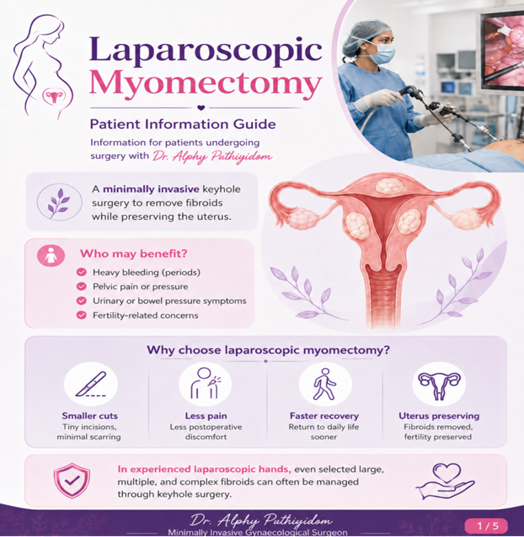
Laparoscopic myomectomy offers the benefits of smaller cuts, less postoperative pain, shorter hospital stay, faster recovery, better cosmetic results, and preservation of the uterus.
However, myomectomy is a technically demanding surgery. The difficulty of the surgery depends mainly on the size, number, depth, and location of the fibroids, as well as the need for careful reconstruction of the uterus after fibroid removal.
In experienced laparoscopic hands, many fibroids that may traditionally be managed by open surgery can often be removed safely through keyhole surgery. This is especially important for women who wish to avoid a large abdominal cut and prefer a faster recovery, while still receiving proper uterine repair.
Laparoscopic myomectomy is commonly suitable for fibroids located within the muscle wall of the uterus or on the outer surface of the uterus.
Fibroids commonly managed by laparoscopic myomectomy include:
The decision is individualized. The important factors are not only the size of the fibroid, but also its location, depth, blood supply, relationship to the uterine cavity, and the number of fibroids.
Very small fibroids may sometimes be difficult to identify during laparoscopy. In practical surgical experience, fibroids above approximately 1.5 cm are more likely to be identifiable and removable laparoscopically, depending on their location.
Open myomectomy may be advised when it is considered the safer option in certain complex cases.
This may depend on:
However, the threshold for open surgery varies depending on the surgeon's expertise in advanced laparoscopic myomectomy. In experienced minimally invasive surgical hands, selected large, multiple, and complex fibroids can often be removed laparoscopically.
The safest route is always individualized for each patient after clinical assessment and ultrasound or MRI review.
The surgery is performed under general anesthesia, so the patient is asleep during the procedure.
Small cuts are made on the abdomen. A camera is inserted through one cut to visualize the uterus and pelvic organs. Fine laparoscopic instruments are inserted through the other cuts.
The fibroid is carefully separated from the uterus. After the fibroid is removed, the uterine muscle is repaired with stitches. This uterine repair is one of the most important steps of the surgery, especially for women planning pregnancy in the future.
The fibroid is then removed from the abdomen. Since fibroids are often larger than the small laparoscopic cuts, they may need to be divided into smaller pieces before removal. In appropriate cases, Dr. Alphy uses contained in-bag morcellation, where the fibroid tissue is placed inside a special bag before being removed in smaller pieces. This technique is used to avoid the tissue spillage inside the abdomen.
If there are suspicious imaging features or safety concerns, morcellation may not be advised, and the surgical plan will be modified accordingly.
Most patients have four small abdominal cuts.
In Dr. Alphy's usual technique, laparoscopic myomectomy is often performed using:
The 12 mm port may be used for safe specimen retrieval using contained in-bag morcellation when appropriate.
The exact number and size of cuts may vary depending on fibroid size, number, previous surgery, adhesions, and safety requirements.
The duration of laparoscopic myomectomy depends on the size, number, location, and depth of the fibroids.
On average, the surgery may take around 2-3 hours. Complex cases may take longer, especially when large and multiple fibroids need to be removed or when conditions like endometriosis are also there with severe adhesions.
The surgeon's experience is important in reducing blood loss, removing fibroids efficiently, performing secure uterine suturing, minimizing unnecessary use of energy sources, and supporting better healing and recovery.
Laparoscopic myomectomy is generally a safe and well-established minimally invasive procedure when performed in appropriately selected patients.
As with any surgery under anesthesia, there are general surgical risks such as bleeding, infection, pain, wound-related issues, blood clots, or reaction to medications. These risks are not unique to myomectomy and can be associated with most surgical procedures.
For myomectomy specifically, the level of risk and complexity depends mainly on the size, number, depth, and location of the fibroids, as well as the presence of adhesions, previous surgery, endometriosis, anemia, or fibroids close to important structures such as the bladder, bowel, ureters, or major blood vessels.
A key factor is the expertise of the surgeon in advanced laparoscopic myomectomy. Careful technique helps reduce blood loss, avoid unnecessary tissue damage, ensure secure uterine repair, and support smoother recovery.
Rarely, if laparoscopic surgery is not safe to continue, conversion to open surgery may be required. This decision is made only for patient safety.
After surgery, you will be monitored in the recovery area for around 1 hour and once stable will be shifted to your room. The nursing team will check your blood pressure, pulse, pain level, urine output, wound dressings, and general condition.
You may feel:
These symptoms usually improve gradually.
Many patients go home the next day after laparoscopic myomectomy. Some patients may need 2 nights in the hospital, especially if the surgery was complex, multiple fibroids were removed, blood loss was higher, or recovery is slower.
Before discharge, you should usually be able to walk, pass urine, eat and drink, and have pain controlled with oral medicines.
During the first few days, rest is important, but complete bed rest is not needed. Gentle walking at home is encouraged.
You may climb stairs slowly if needed. Eat according to your appetite. You can gradually return to normal food, but avoid very spicy or oily food if it causes acidity, nausea, or bloating.
Mild pain, bloating, tiredness, and shoulder-tip discomfort are common and should improve day by day.
Most patients gradually return to light daily activities. Gentle walking is encouraged.
Avoid heavy household work, lifting heavy bags, lifting children, intense exercise, running, abdominal workouts, prolonged standing, swimming, sexual intercourse, and tampon use.
In uncomplicated cases, many patients doing desk-based or office work may be able to return to work after around 10-14 days, provided they feel comfortable and are not taking strong painkillers.
Patients with physically demanding work may need more time.
By 3-4 weeks, many patients feel much better. You may be able to resume office work if not already started. Driving may be considered if you are comfortable wearing a seat belt, are not taking sedating pain medicines, and can perform an emergency brake safely.
Heavy lifting, strenuous exercise, gym workouts, running, swimming, tampon use, and sexual intercourse are usually avoided for about 4-6 weeks, or until your doctor confirms that healing is satisfactory.
This is important because the uterus has been repaired internally and needs time to heal.
Your small abdominal wounds may be closed with dissolvable stitches, skin glue, or dressings.
General wound care advice
Contact your doctor if you notice:
Mild itching can happen as the wound heals, but severe itching or rash may be due to dressing allergy and should be checked.
A healthy diet helps wound healing, bowel recovery, and energy levels.
Recommended diet
Constipation prevention
Constipation is common after surgery because of anesthesia, reduced movement, pain medicines, and iron tablets.
To reduce constipation:
You may be given:
Take medicines exactly as prescribed.
Please contact your doctor or go to emergency care if you have:
No. In myomectomy, only the fibroids are removed, and the uterus is preserved. This is why myomectomy is commonly chosen by women who wish to retain the uterus or plan future pregnancy.
Not always. Suitability depends on size, number, location, depth, and surgical complexity. In experienced laparoscopic hands, selected large, multiple, and complex fibroids can often be removed through keyhole surgery.
Open myomectomy may be advised when it is considered the safer or more appropriate option. This may depend on fibroid size, number, depth, location, expected blood loss, operating time, and complexity of uterine repair.
However, the need for open surgery varies depending on the surgeon's experience in advanced laparoscopic myomectomy. Dr. Alphy routinely evaluates each case carefully to decide whether a minimally invasive approach is safe and suitable.
Most patients have four small cuts. In Dr. Alphy's usual technique, this often includes three 5 mm ports and one 12 mm port. The 12 mm port may be used for contained in-bag specimen retrieval when appropriate.
Pain is usually mild to moderate and controlled with pain medicines. You may feel abdominal soreness, bloating, bruising around the cuts, and shoulder-tip pain for a few days.
The pain should improve day by day. Severe or worsening pain should be reported.
The surgery usually takes around 2-3 hours, but it may be shorter or longer depending on the number, size, and location of the fibroids.
Complex cases with multiple, deep, or large fibroids may take longer.
For desk-based work, many patients can return after around 10-14 days if recovery is smooth.
Physically demanding work may require 4-6 weeks or longer.
Gentle walking can usually start soon after surgery.
Strenuous exercise, weight training, running, abdominal workouts, swimming, and heavy lifting are usually avoided for about 4-6 weeks or until your doctor gives clearance.
Sexual intercourse is usually avoided for about 4-6 weeks or until your doctor confirms that healing is satisfactory.
This is important because the uterus has been repaired internally.
Yes, many women can conceive after myomectomy, especially if fibroids were affecting fertility or distorting the uterine cavity.
However, pregnancy should be planned only after the uterus has healed. In most cases, the recommended waiting period varies from around 3-6 months, depending on the size, number, and depth of fibroids removed and how the uterus was repaired.
Some women may be advised to have a planned cesarean section in a future pregnancy, especially if the fibroid was deep within the uterine muscle, multiple fibroids were removed, or the uterine cavity was entered during surgery.
Your surgeon will discuss this based on your operative findings. It is useful to keep a copy of your operation note for your future obstetrician.
The fibroids removed during surgery do not grow back. However, new fibroids can develop later.
This is more likely in younger women and in women with multiple fibroids. Follow-up is important if symptoms return.
If fibroids were causing heavy bleeding, prolonged bleeding, or anemia, periods often improve after recovery.
However, the first one or two periods after surgery may be slightly different from usual. They may be early, delayed, heavier, lighter, or more painful. This usually settles. If heavy bleeding continues, further evaluation may be needed.
The aim is to remove the fibroids that are causing symptoms or are clinically significant.
Very tiny fibroids may not be removed if they are difficult to identify. Your surgeon will discuss realistic expectations before surgery.
Morcellation is a method used to remove larger fibroids through small laparoscopic cuts by dividing the tissue into smaller pieces.
When appropriate, Dr. Alphy uses contained in-bag morcellation to avoid tissue spillage inside the abdomen. Morcellation is avoided when there are suspicious features or when it is not considered safe.
Yes, rarely. Conversion to open surgery may be needed if there is heavy bleeding, dense adhesions, difficult anatomy, unexpected findings, or if completing the surgery laparoscopically is not safe.
This decision is made for patient safety.
Most patients do not need a blood transfusion. However, bleeding is a known risk of myomectomy because fibroids have a blood supply and the uterus needs to be repaired after removal.
If you are anemic before surgery, iron treatment or other preparation may be advised before the operation.
Mild spotting or light vaginal bleeding can happen after surgery.
Heavy bleeding, large clots, foul-smelling discharge, fever, or severe pelvic pain should be reported urgently.
You can drive when you are comfortable, not taking strong or sedating painkillers, able to wear a seat belt, and able to perform an emergency brake without pain.
For many patients, this may be around 2-3 weeks, but it depends on individual recovery.
Yes. Follow-up is important to check wound healing, review the histopathology report, discuss your recovery, review your periods, and plan pregnancy advice if relevant.
Laparoscopic myomectomy is an effective uterus-preserving surgery for selected women with symptomatic fibroids. In experienced minimally invasive surgical hands, even selected large, multiple, and complex fibroids can often be treated through keyhole surgery.
Dr. Alphy Puthiyidom's approach to laparoscopic myomectomy focuses on careful patient selection, precise fibroid removal, reducing blood loss, secure uterine repair, safe specimen retrieval, and smooth postoperative recovery.
Every patient is different. The best treatment plan depends on the size, number, and location of fibroids, symptoms, fertility plans, imaging findings, and surgical findings. Please discuss your individual case, recovery instructions, specimen retrieval method, and future pregnancy plan with Dr. Alphy before the procedure.

MBBS, MD (Obs & Gyn), FMIS (Laparoscopy)
Minimally Invasive Gynecological Surgeon
Expert In Uterine Fibroids