
Why your tummy may be getting bigger even when your weight hasn’t changed—and when fibroids could be the reason.
Have you noticed that your tummy is gradually getting bigger, your clothes are becoming tighter around your waist, or you feel a persistent swelling in your lower abdomen?
You may assume that you are putting on weight. But sometimes, the reason is something entirely different.
Large uterine fibroids can cause noticeable abdominal enlargement, even in women who have no significant pain or heavy menstrual bleeding.
Over the years, I have seen many women come to my clinic with a similar concern.
They tell me, “Doctor, I noticed my tummy was getting bigger. I thought I was putting on weight, so I started going to the gym, exercising regularly and trying to lose weight. But no matter what I did, my tummy just wouldn’t go down.”
Some women notice a lump or unusual firmness in their lower abdomen.
Interestingly, because fibroids often grow gradually over months or years, many women do not realise how much their abdomen has enlarged. They become accustomed to the slow change in their body shape.
Sometimes, it is a family member or friend who first notices the swelling, particularly someone meeting them after a long time. Only then do they realise that their abdomen has become unusually prominent.
When they eventually come for an examination and ultrasound, we sometimes discover that the reason is not weight gain at all, but a large uterine fibroid—or multiple fibroids—that have gradually enlarged the uterus.
What surprises many women is that they may have completely normal periods and no significant pain.
This is something I often emphasise to my patients: not every growing tummy is due to weight gain, and not every fibroid causes heavy bleeding or pain.
Uterine fibroids are non-cancerous growths that develop from the muscular wall of the uterus. They are very common during the reproductive years.
Many fibroids remain small and cause no symptoms. However, some grow large enough to increase the overall size of the uterus.
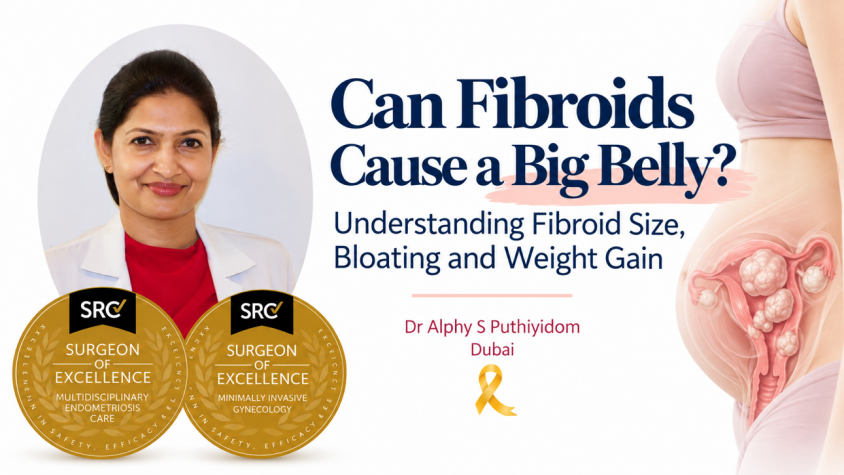
Normally, the uterus is a relatively small organ located within the pelvis. When large fibroids develop, the uterus can extend upwards into the abdomen, producing a visible bulge.
Women may notice:
In some cases, a significantly enlarged fibroid uterus can make the abdomen appear similar to that of a pregnant woman.
However, not every abdominal swelling is caused by fibroids. Other conditions can produce similar changes, making proper assessment important.
Small fibroids do not usually cause visible abdominal enlargement.
However, the symptoms caused by fibroids depend on their location as well as their size.
For example, a fibroid pressing against the bowel may contribute to constipation or abdominal fullness. A fibroid pressing on the bladder may cause urinary frequency.
Bloating itself is common and can result from gastrointestinal conditions, dietary factors or hormonal changes.
If your bloating is persistent, it is important not to assume that fibroids are necessarily the cause.
Fibroids do not directly cause an increase in body fat.
However, large fibroids add tissue mass, and a significantly enlarged uterus can contribute to an increase in body weight.
Some women feel that they have gained weight because their abdomen looks bigger, even when their overall weight has changed very little.
There is an important difference between:
An ultrasound examination can help determine whether fibroids are contributing to the abdominal enlargement.
Yes, but size is not the only factor.
A large fibroid growing towards the outer surface of the uterus may cause abdominal enlargement or pressure symptoms.
On the other hand, even a small fibroid growing into the uterine cavity can cause significant heavy menstrual bleeding without making the abdomen look bigger.
The number, size and location of fibroids are all important when assessing symptoms and deciding on treatment.
This is why a detailed ultrasound examination should evaluate the entire uterus rather than simply measure the largest fibroid.
Pelvic ultrasound is usually the first investigation for suspected uterine fibroids.
Depending on the size of the uterus and the patient’s circumstances, transabdominal and transvaginal ultrasound may be used.
A detailed ultrasound assessment can identify:
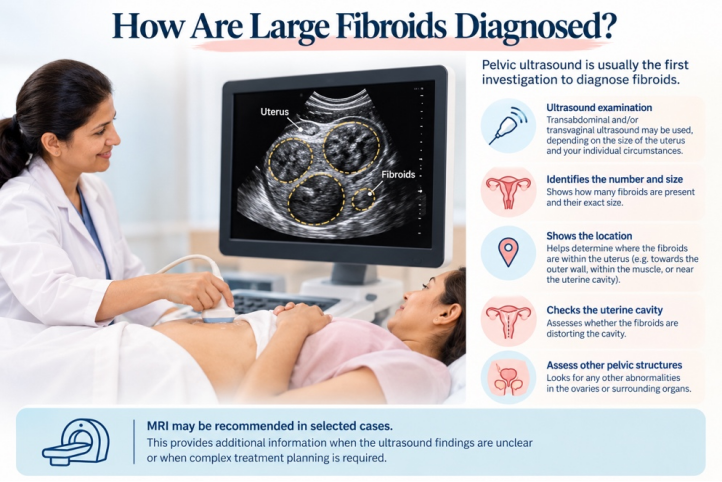
For women with multiple or large fibroids, fibroid mapping can be particularly valuable when planning treatment. MRI may be recommended in selected cases when additional anatomical information is required.
Treatment depends on the size and location of the fibroids, severity of symptoms, age, fertility plans and personal preferences.
If the fibroids are not causing significant problems and if the size is not big, monitoring may be appropriate.
However, when fibroids cause troublesome abdominal enlargement, pressure symptoms, heavy bleeding or other complications, treatment may be considered.
For women who wish to preserve their uterus, myomectomy is a surgical option that removes fibroids while retaining the uterus.
Depending on the fibroid characteristics, laparoscopic or robotic-assisted myomectomy may be suitable for selected patients.
The decision should always be individualised.
If the abdominal enlargement is mainly caused by large fibroids, removing them can reduce the size of the uterus and may make the abdomen noticeably smaller.
However, the degree of change varies from woman to woman.
Fibroid removal will not directly reduce abdominal fat or treat bloating caused by unrelated gastrointestinal conditions.
It is important to have realistic expectations and understand what changes can be expected after treatment.
Yes. Very large fibroids or multiple fibroids can enlarge the uterus enough to produce a pregnancy-like abdominal appearance.
A single 5 cm fibroid does not usually cause marked abdominal enlargement. However, the effect depends on its location, the presence of other fibroids and the overall uterine size.
Large fibroids may contribute to persistent abdominal fullness or pressure. However, daily bloating can have other causes and should not automatically be attributed to fibroids.
No. Fibroids do not directly increase abdominal fat. They can enlarge the uterus, making the tummy appear bigger.
If abdominal enlargement is mainly caused by fibroids, the tummy may become smaller after surgery. However, a completely flat abdomen cannot be guaranteed.
Seek medical assessment if you notice progressive abdominal enlargement, a persistent lump, pelvic pressure, heavy bleeding or new bladder or bowel symptoms. Sudden severe pain or heavy bleeding accompanied by dizziness requires urgent medical attention.
If your abdomen is gradually getting bigger despite exercise or weight-management efforts, or if you notice an unusual swelling in your lower abdomen, it is worth having a proper assessment.
Even if your periods are normal and you have no significant pain, a large fibroid could still be present.
The important question is not simply “How big is my fibroid?” but “Is this fibroid causing my symptoms, and does it need treatment?”
At Mediclinic Welcare Hospital, Dubai, Dr. Alphy S. Puthiyidom provides advanced gynaecological ultrasound assessment, fibroid mapping and minimally invasive surgical treatment, including laparoscopic myomectomy.
A personalised consultation can help you understand your fibroids and whether monitoring or treatment is appropriate.
Book a consultation to discuss your symptoms and available treatment options.
Medical disclaimer: This article is intended for general patient education and does not replace individual medical assessment or advice.
MBBS, MD(Obs&Gn),FMIS(Laparoscopy)
Head of the Department
Advanced Gynecological Laparoscopic Surgeon
& Pelvic Reconstructive Surgeon
MEDICLINIC WELCARE HOSPITAL
Al Garhoud, Dubai
MEDICLINIC PARKVIEW HOSPITAL
Umm Sequim, Al Barsha South 3, Dubai
Appointments 800-1999
www.mediclinic.ae