
When a woman walks into my clinic after being told she has fibroids, the first thing I often see is fear - fear of surgery, fear of losing the uterus, fear of long recovery, or fear about future fertility. And almost always, the first question is not “What surgery do I need?” but rather “Doctor… is there any way to treat this without surgery?”
The good news is - yes, in many cases there is. Modern gynecology has evolved significantly, and today we have several uterus-preserving, minimally invasive options, one of the promising being Radiofrequency Ablation (RFA).
Not all fibroids need surgery. Treatment depends on symptoms, size, location, age, and future pregnancy plans.
Broadly, non-surgical or minimally invasive options include:
Birth-control pills or progesterone therapy
Tranexamic acid for heavy bleeding
GnRH analogues or antagonists (temporary shrinkage)
Radiofrequency Ablation (RFA)
Uterine Fibroid Embolization (UFE/UAE)
High-Intensity Focused Ultrasound (HIFU)
Transcervical fibroid ablation systems
These approaches aim to reduce symptoms and shrink fibroids rather than remove the uterus.
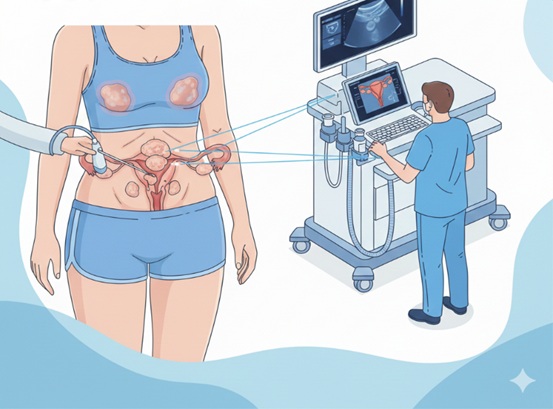
I usually explain RFA to my patients in very simple terms:
“We use controlled heat energy to shrink the fibroid from the inside, without removing the uterus.”
A small needle-like probe is guided into the fibroid using ultrasound or laparoscopy.
The probe emits radiofrequency heat, which destroys the fibroid tissue. Over the next few months, the fibroid shrinks naturally, and symptoms improve.
There are no large cuts, no stitches, and no removal of the uterus, which is why many women feel relieved when they learn about this option.
Each treatment works differently:
RFA – Targets the fibroid directly with heat from inside.
UFE/UAE – Blocks the blood supply to fibroids through arteries.
HIFU – Uses focused ultrasound waves from outside the body.
RFA is often preferred by patients who want precision, faster recovery, and minimal impact on surrounding tissues.
In my practice, RFA works best for women who:
Have heavy bleeding, pain, or pressure symptoms
Have fibroids usually between 2–7 cm
Have intramural or some subserosal fibroids
Want to avoid hysterectomy
Prefer short downtime
Are nearing menopause but still symptomatic
Every uterus is unique, so imaging and proper assessment are essential before deciding.
Yes. RFA is backed by clinical studies, international guidelines, and regulatory approvals in many countries.
When performed by trained specialists, complication rates are low, and patient satisfaction is high.
Most women experience:
Lighter and more regular periods
Relief from pelvic pressure or bloating
Gradual fibroid shrinkage over 3–6 months
Same-day discharge or short hospital stay
Quick return to work and routine life
Many patients tell me, “I wish I knew about this earlier.”
No medical procedure is entirely risk-free, but RFA risks are generally mild and temporary:
Cramping for a few days
Mild fever
Vaginal discharge for a few weeks
Rare infection or bleeding
Injury to nearby organs
Serious complications are rare.
This is a very common concern.
RFA does not remove the uterus, and several women have conceived after the procedure.
However, if a patient’s primary goal is immediate pregnancy, we individualize the plan carefully and discuss all options transparently.
Most women go home the same day
Return to light activity in 2–3 days
Resume work within a week
Pain is usually manageable with simple medication
Compared to open surgery, the recovery difference is significant.
Not always. RFA is ideal for intramural and some subserosal fibroids. Very large fibroids, heavily calcified ones, or certain submucosal types may need alternative approaches.
The key is choosing the right treatment for the right fibroid.
Some women notice improvement in their next menstrual cycle, while for others, it becomes more evident by 3–6 months, as fibroids gradually shrink.
The treated fibroid does not regrow.
However, new fibroids can develop over time because fibroids are hormonally influenced.
Regular follow-up helps monitor this.
Depending on fibroid position, RFA can be performed:
Transcervical – through the cervix, no incisions
Transvaginal – ultrasound-guided via vagina
Laparoscopic – keyhole abdominal approach
Each has its own indications and advantages.
The most important thing I tell my patients is this:
You are not alone, and you are not out of options.
Fibroid treatment is no longer one-size-fits-all. The best plan is one that aligns with your symptoms, age, lifestyle, and future goals.
Radiofrequency Ablation is not for everyone — but for the right patient, it can be a life-changing, uterus-preserving solution that bridges the gap between medication and major surgery.
And sometimes, simply knowing that such an option exists brings immense relief even before the treatment begins.
MBBS, MD(Obs&Gn),FMIS(Laparoscopy)
Advanced Gynecological Laparoscopic Surgeon
& Pelvic Reconstructive Surgeon
MEDICLINIC WELCARE HOSPITAL
Al Garhoud, DubaiMEDICLINIC PARKVIEW HOSPITAL
Umm Suqeim, Al Barsha South 3, Dubai